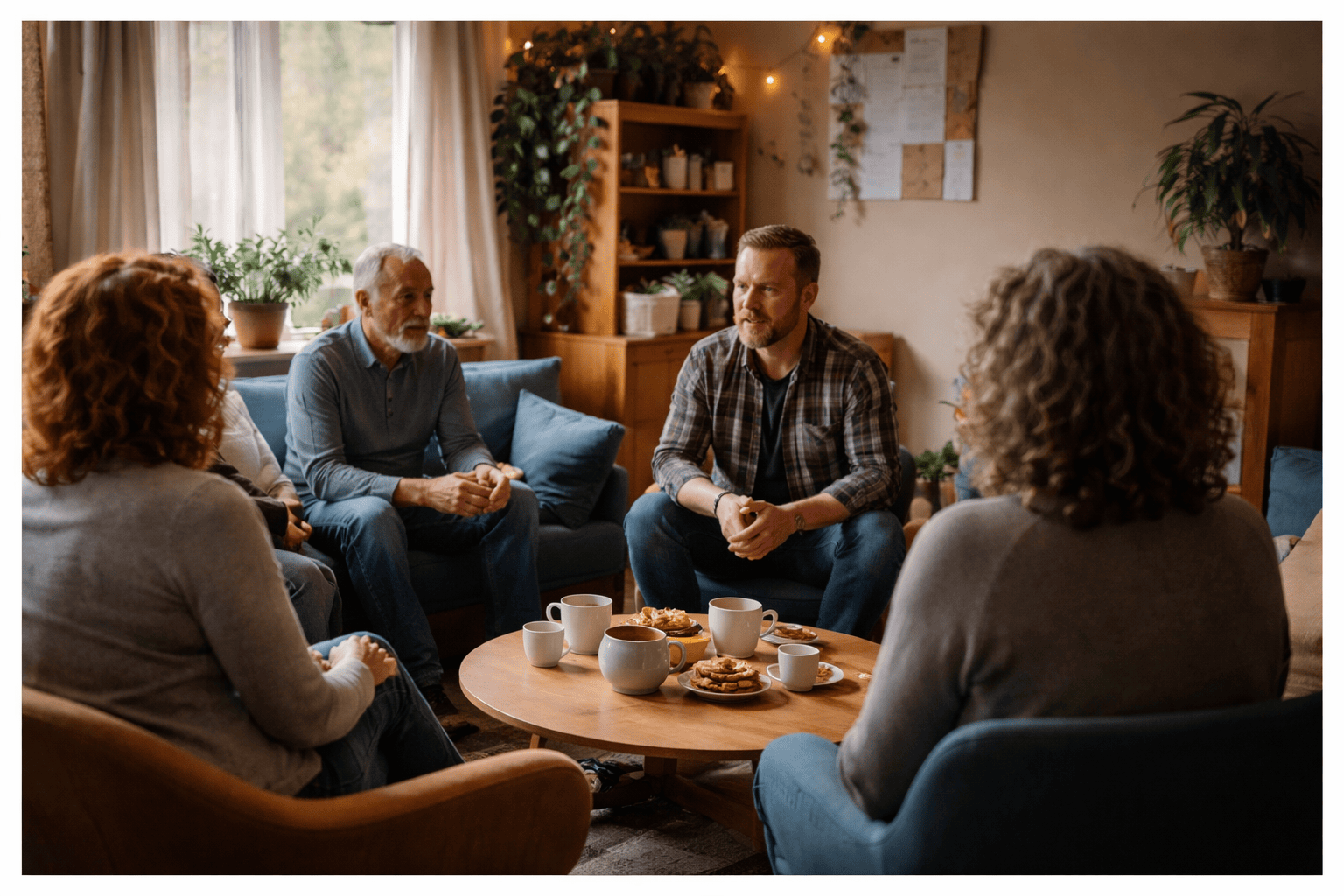
You Don’t Need to Be ‘Good at Talking’ to Come Along
There’s a quiet assumption that sits underneath most community groups, whether anyone says it out loud or not.
It goes something like this:
“You probably need to be reasonably confident, fairly open, and at least a bit comfortable talking about yourself.”
And if you don’t feel like that applies to you, it’s very easy to decide that these sorts of things are “not really for people like me”.
Which is understandable.
Also, in most cases, completely wrong.
The Unspoken Barrier
When people hesitate about coming to something new, it’s rarely about the activity itself.
It’s not usually:
- the journalling
- the woodworking
- the tea and biscuits
It’s this:
“What if I don’t know what to say?”
“What if I feel awkward?”
“What if everyone else seems more comfortable than I am?”
And underneath all of that, a more blunt version:
“What if I make a bit of a fool of myself?”
That’s the bit people don’t tend to say out loud.
But it’s often the deciding factor.
A Useful Reality Check
Here’s the part that tends to surprise people.
Most of the people who walk into a session for the first time are thinking exactly the same thing.
They may not show it.
Some will sit quietly.
Some will talk more than they normally would.
Some will make a joke out of it.
But internally, there’s usually some version of:
“Let’s just see how this goes.”
So if you’re imagining a room full of people who are completely at ease, effortlessly open, and immediately comfortable…
That’s not what tends to happen.
What you actually get is a group of people, each doing their own version of “giving it a go”.
What Actually Happens
Let’s remove a bit of the mystery.
A typical session is not a performance.
You’re not expected to:
- introduce yourself in a dramatic or meaningful way
- share anything you don’t want to share
- “open up” on demand
- have the right words ready at the right time
Instead, what tends to happen is much more straightforward.
You arrive.
You’re welcomed in a normal, human way.
There’s usually a bit of light conversation, or not, depending on what you prefer.
Then the session begins.
If it’s journalling, you’ll be given a prompt and some quiet time to write.
If it’s Head in the Shed, you’ll have something practical to focus on, alongside conversation that comes and goes naturally.
If it’s a social group, you can join in, listen, or simply sit with a cup of tea.
There is no point at which someone turns to you and says:
“Go on then. Tell us something meaningful about yourself.”
That simply isn’t how it works.
What Doesn’t Happen (This Matters)
Sometimes it’s just as important to be clear about what won’t happen.
You will not be:
- put on the spot
- expected to speak if you don’t want to
- analysed, diagnosed, or “worked on”
- asked to justify why you’re there
There is no hidden agenda.
No one is keeping score.
No one is waiting for you to “do it properly”.
The Role of the Group
One of the things that often gets overlooked is how the group itself behaves.
Over time, a kind of unspoken understanding tends to form:
- people give each other space
- conversations are allowed to be ordinary
- silence is not treated as a problem
- humour is very much welcome
It’s not about everyone becoming deeply connected in an instant.
It’s about creating an environment where:
being there is enough
That might not sound like much.
But for a lot of people, it’s exactly what’s been missing.
If You’re Unsure
If you’re reading this and thinking:
“I’m not sure I’d be any good at something like that”
Then it’s worth gently challenging that idea.
Because “being good at it” isn’t really a requirement.
You don’t need to:
- be confident
- be articulate
- have anything particularly insightful to say
You just need to be willing to turn up.
And even that can feel like a big step.
A More Honest Way of Looking at It
Instead of asking:
“Will I be good at this?”
It’s often more helpful to ask:
“Would it do me some good to be in a different environment for a couple of hours?”
- away from the usual routine
- around other people, without pressure
- doing something simple and grounded
That’s the level we’re working at.
Not transformation.
Not breakthrough moments.
Just a slightly better couple of hours than you might otherwise have had.
Final Thought
You don’t need to arrive as a different version of yourself.
You don’t need to prepare anything.
You don’t need to prove anything.
You can arrive exactly as you are, sit down, and see how it goes.
That’s enough.